Field notes / mechanics
Keywords, followers and the squad
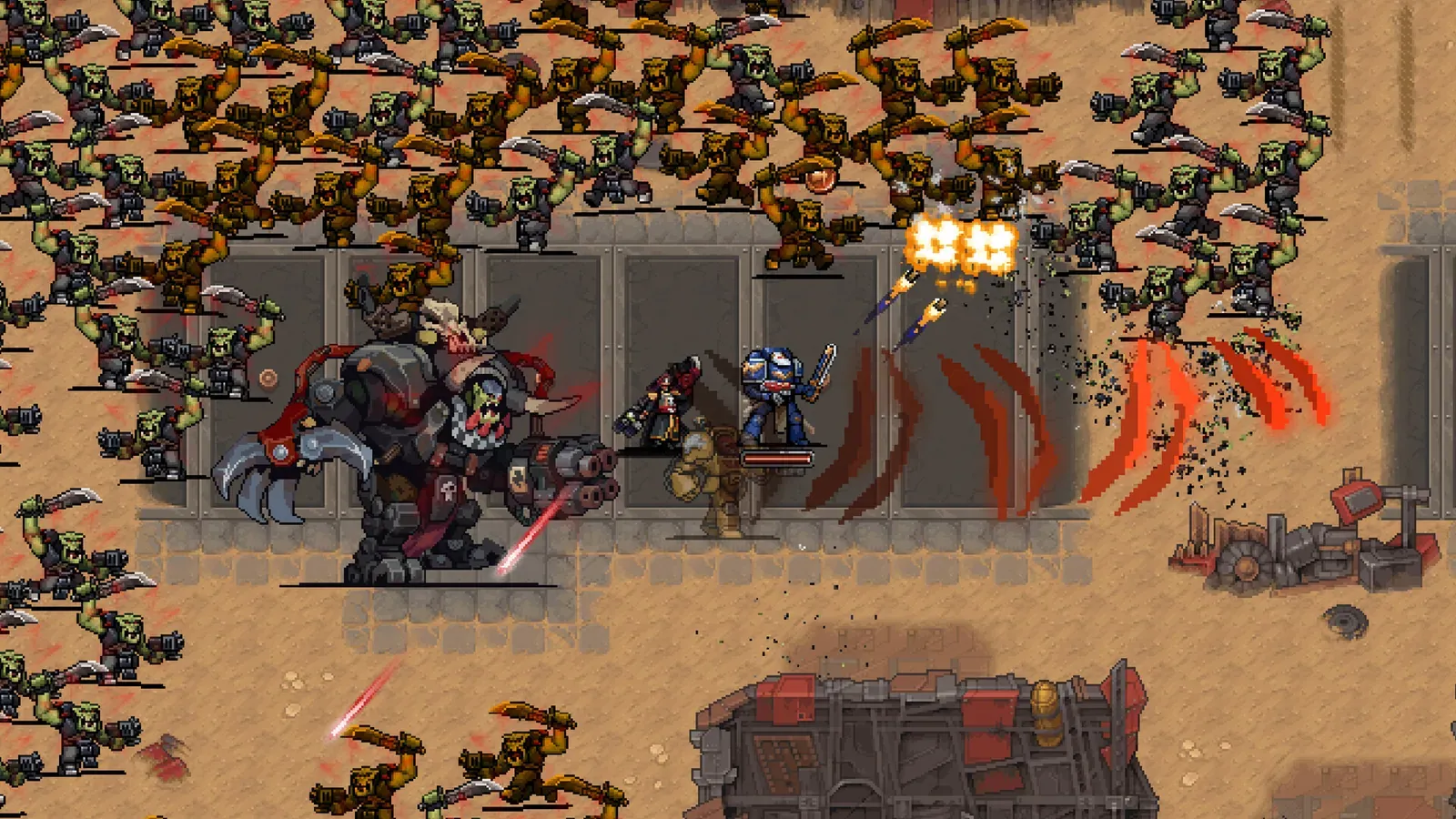
Warhammer Survivors is single-player, but you rarely fight alone. The keyword system lets an off-kit weapon summon a follower who attacks for you and cannot be damaged. It is the most important mechanic for turning a random weapon drop into a real build.
On this page6 sections
The system is simple to state and easy to misread. A champion does not simply “use” every weapon. Keywords decide who can wield what. When the answer is no, the game does not waste the weapon; it sends someone who can use it.
What keywords do
Auroch’s October Squad System feature says every character, weapon and some items carry one or more keywords. If a champion acquires a weapon their keywords do not allow, an ally with the right keywords joins the squad as a follower. This is not a penalty for a bad drop. It is a second way to convert a weapon into damage.
The most obvious examples are signature weapons. Marneus Calgar’s Gauntlets of Ultramar and Gotrek’s Zangrom-Thaz are tied to their champions. Other champions can still access those results through evolutions, but the resulting ally is the champion who owns the weapon, not a generic duplicate.
Follower rules
Followers attack on the player’s behalf. They cannot take damage and cannot collect items. That makes them an extension of your area of effect with no extra health bar to manage. Several followers can squad up with one champion, and the official material describes the result as a small squad rather than a single summoned pet.
- Followers are damage, not bodies. They do not block enemies or absorb hits.
- They cannot collect experience or pick-ups, so your movement still controls the economy.
- Multiple followers can join the same champion.
- Playing as the follower champion can prevent a duplicate from being summoned.
Practical consequence: a follower build should value weapons that add coverage, not weapons that require you to protect a second unit. The follower is already safe. Your positioning remains the only defence that matters.
Documented squad combos
The Castellan and Trooper Kozlowski
The Black Templars Castellan’s attack power and skill increase with every follower gained. Kozlowski’sLasgun adds Cadian Shock Troopers as it levels. Put them together and each Cadian from the Lasgun line contributes to the Castellan’s damage. This is the clearest official reason to treat the Lasgun as a launch meta weapon rather than a starter rifle.
The catch is availability: the Castellan is not in the October demo. The combo is confirmed as a design interaction, not as a demo-tested power level. Its practical value depends on unlock costs and how many followers the launch build allows.
Bastian Carthalos and Lorai
Bastian’s Uskavar the Sunderer hits in specific close-range patterns. Lorai’s Nebulous Sea Fog draws enemies in and damages them. The official combo uses Lorai to pull enemies into Bastian’s damage zones. It is a grouping engine: the fog does the herding, and the hammer does the work.
Neither champion appears in the October demo. Treat the pair as a launch target and a reminder that follower synergy is not only about raw damage. Control can be the setup that makes another champion’s pattern function.
Gotrek and the Fyrestorm line
Evolving the Fyrestorm Greataxe calls Gotrek Gurnisson to your side with Zangrom-Thaz. If you are already playing as Gotrek, the evolution does not spawn a clone. The passive required for the evolution is still unannounced, so this combo belongs in the launch test list rather than a fixed build.
Signature weapons and the keyword trap
Signature weapons are powerful because they reinforce a champion’s identity, but they also narrow the weapon pool. A champion restricted to a signature weapon cannot freely swap into a generic weapon without triggering the follower system. That is not automatically bad; a follower is still damage. The mistake is assuming the weapon’s full value transfers to the champion holding it.
When a weapon is tied to a champion, plan around the follower’s attack pattern, not just the weapon’s name. If the champion’s pattern is close-range and your current build is ranged, the follower may not solve the problem you actually have.
Build implications
The squad system rewards breadth with a purpose. A weapon you cannot wield is still useful if the follower’s damage fits your build. That makes “off-kit” picks less wasteful than they first appear, especially for a champion like the Castellan whose damage scales with the number of followers.
- Count the follower as a damage source when comparing weapons, not as a wasted slot.
- Prefer followers whose attack pattern matches the range you already fight at.
- Do not spend defensive upgrades on followers; they cannot be damaged.
- For Castellan builds, Lasgun upgrades are effectively double-dipping into his damage.
- Check whether a signature weapon prevents the follower interaction entirely.
Demo limits and launch checks
The October demo exposes the follower system in play, but the full keyword list is not public. We do not know every champion’s keyword set, every weapon restriction or the final follower count. Auroch says more combinations will be discoverable at launch.
At launch, test three things: whether an off-kit weapon always summons a follower, whether playing as the follower champion blocks the duplicate, and whether the Castellan’s damage scales with every Cadian from the Lasgun line. Thebuild planner can hold the weapon and champion while you test.
Sources and evidence
Editorial methodOfficial claims, press observations and community reports are kept separate. Where Auroch has not published a value, this guide says so instead of filling the gap.